How to Compare Replacement Windows
Three salespeople can describe three windows three completely different ways. Skip the sales language. Ask every contractor the same questions, compare the same certified numbers, and understand what you are actually buying.
Window styles: choose how each opening works
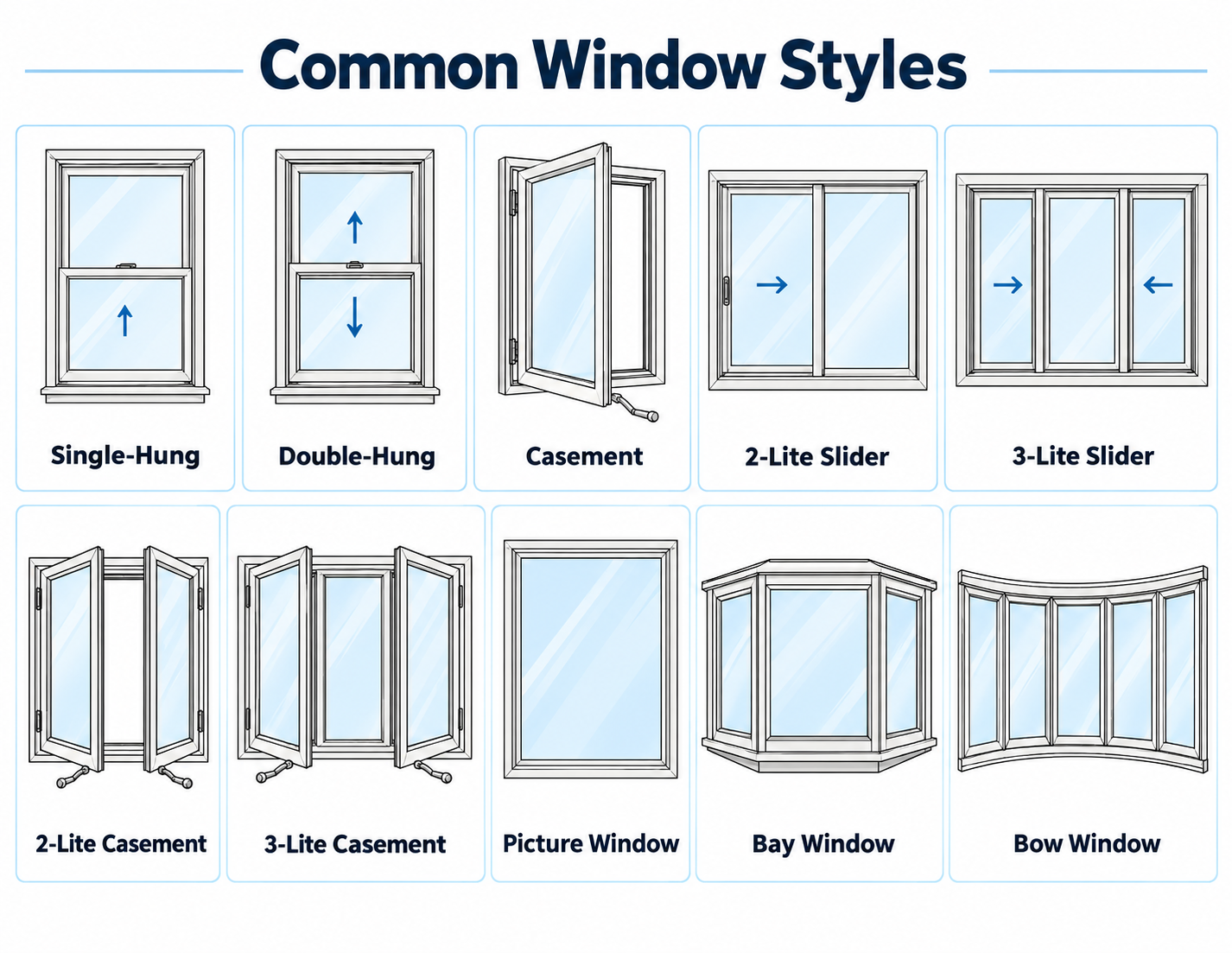
Compare how each style opens, how much ventilation it provides and whether it fits the room. A picture window is fixed; a bay or bow combines several units. Confirm which units open.
“Which style fits each opening, and which sections actually open?”
Single-hung vs. double-hung: cleaning upstairs
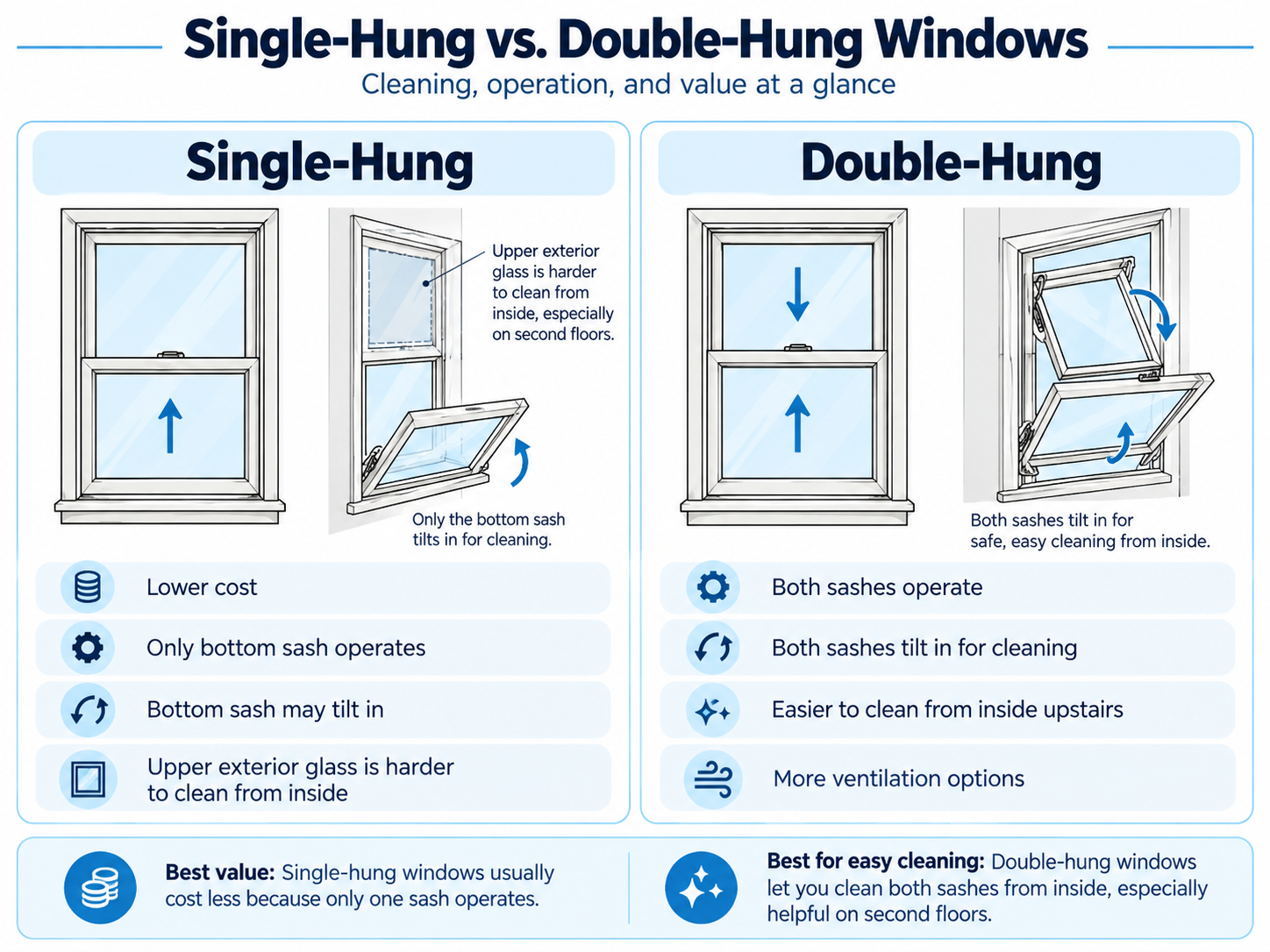
Single-hung windows have a fixed upper sash and an operating lower sash. Double-hung windows have two operating sashes. Tilt-in features vary by model; ask for a demonstration of how to clean both exterior glass surfaces from inside.
“Can I clean both sashes from inside on the second floor, and can you demonstrate it?”
DP / PG: strength under pressure
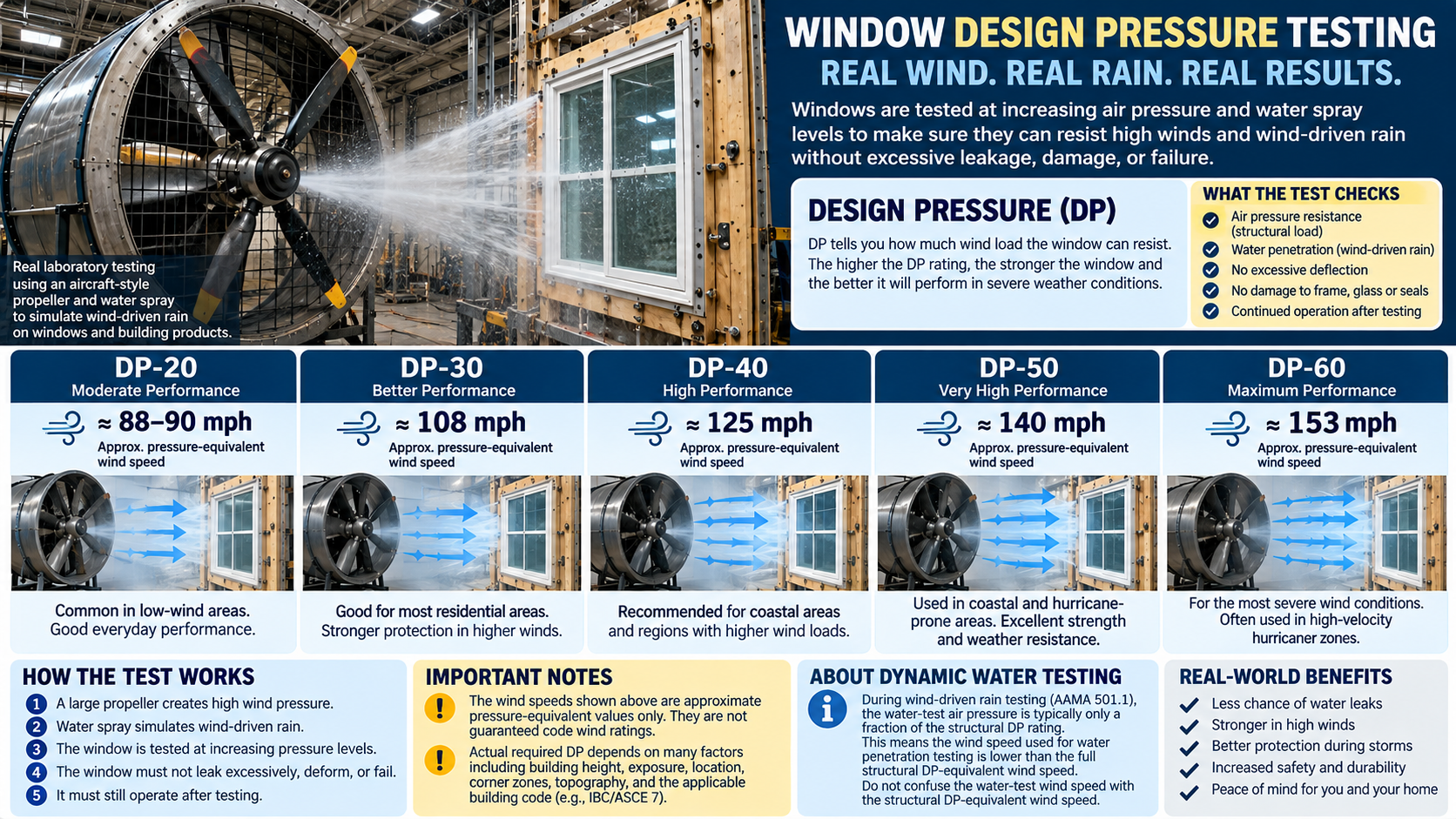
Design Pressure (DP) relates to structural pressure performance. Performance Grade (PG) requires the applicable structural, water-penetration and air-leakage tests. Pressure is commonly expressed in pounds per square foot (psf).
Wind loading depends on building height, exposure, location and other variables. Have the contractor confirm the rating meets your project requirements. Ask for certified product information if the salesperson does not know.
“What is the certified DP or PG rating for this exact window and configuration?”
See wind-driven rain testing in action
Propeller-test excerpt: Anderson Aluminum — Unitized Curtain Wall Design and Testing. The embedded player jumps directly to the dynamic wind-and-water testing portion. The footage shows an airplane-propeller dynamic water test using wind and spray. This is not the York, Pennsylvania Intertek/ATI laboratory, but it is the same type of AAMA 501.1 dynamic water-testing concept. Open testing excerpt on YouTube (1:22) ↗ · Read Intertek’s AAMA 501.1 test description ↗
A large propeller creates high-velocity wind while water is sprayed at the test specimen. This lets a laboratory evaluate how a window, door or wall system resists wind-driven rain under controlled conditions.
Design Pressure and Performance Grade testing also use controlled pressure and structural-load procedures. The fan demonstration is dramatic, but it is only one part of the full performance picture.
U-Factor: lower means less heat transfer
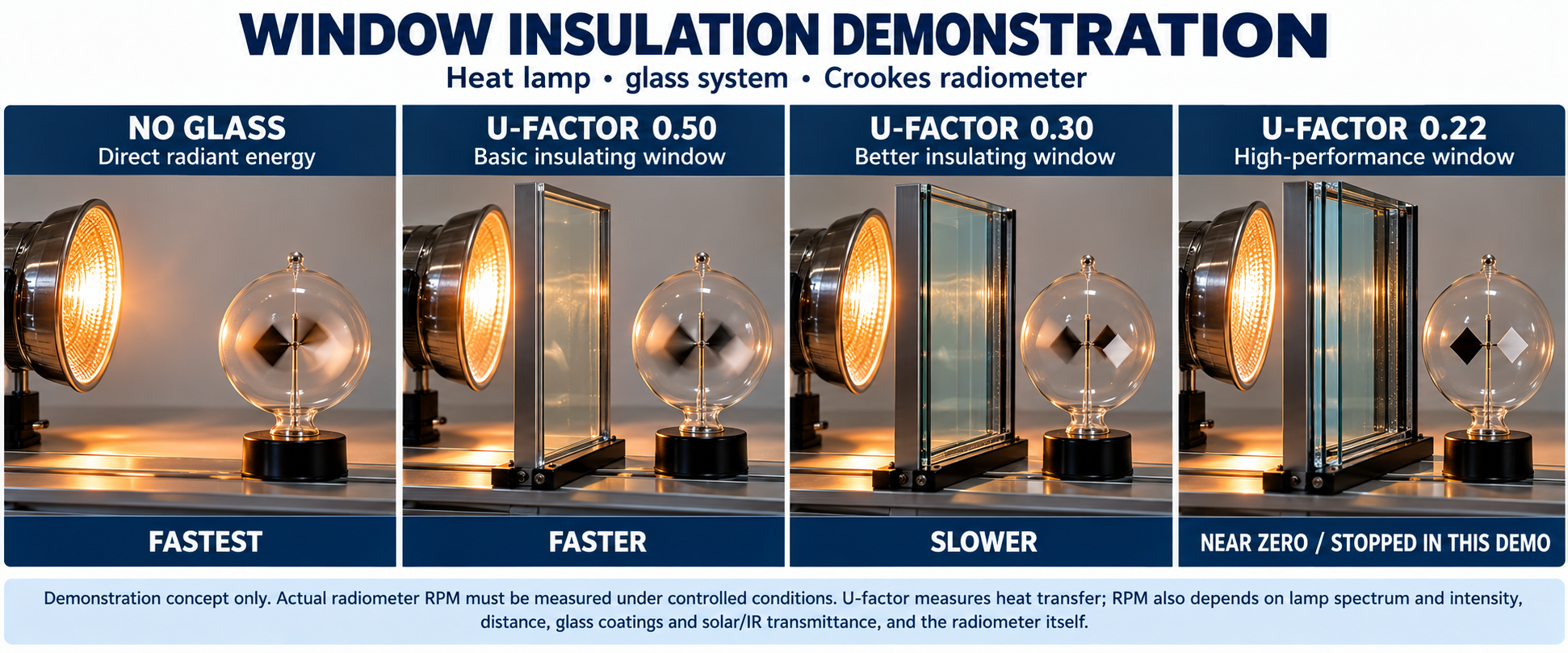
U-Factor describes the rate of heat transfer through the complete window assembly, including its frame and glass. Compare NFRC-certified whole-window values; a center-of-glass number leaves out the rest of the window.
“What is the NFRC-certified whole-window U-Factor for this exact window?”
SHGC: how much of the sun’s heat gets in?
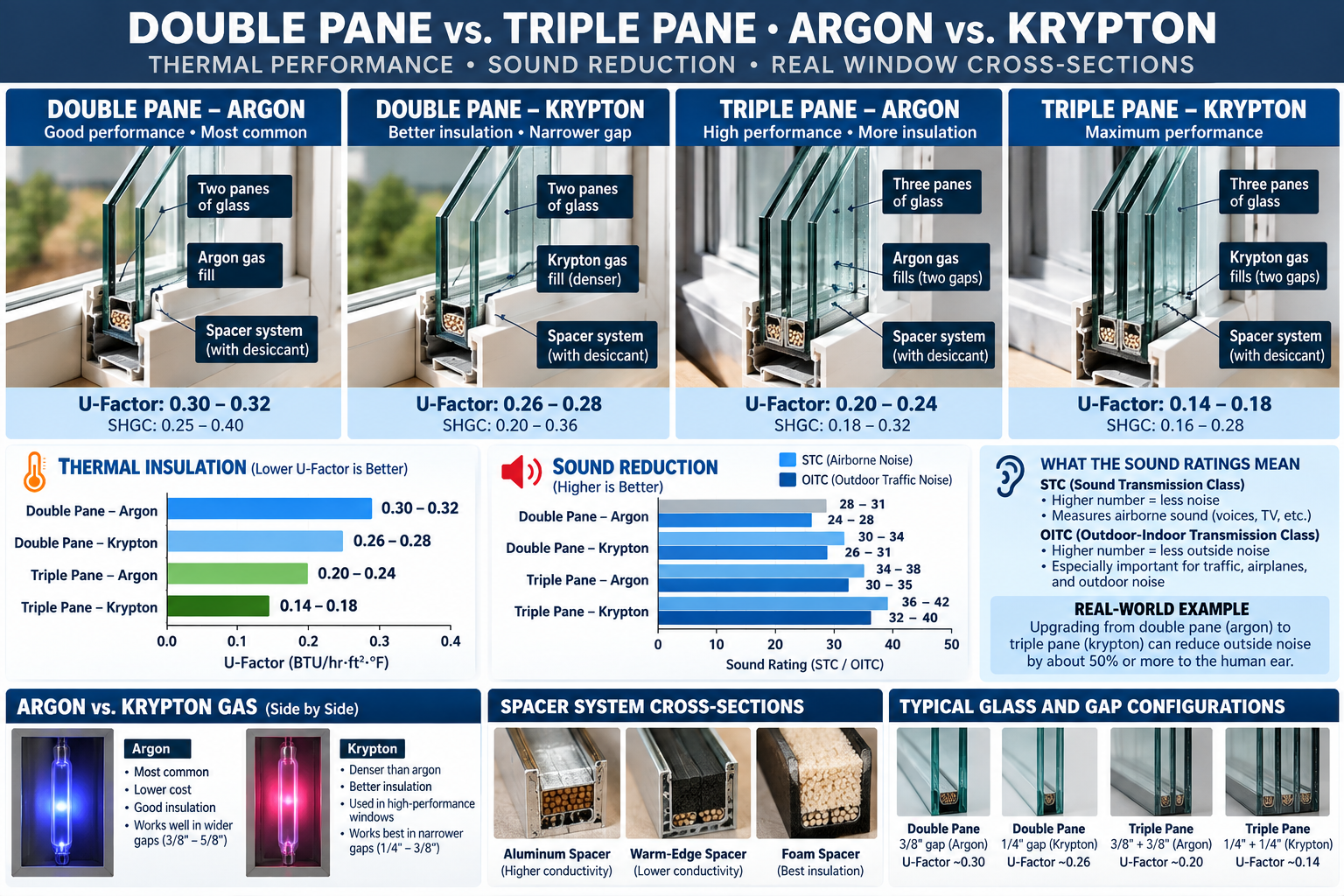
Solar Heat Gain Coefficient (SHGC) represents the fraction of solar energy entering through the window, including directly transmitted energy and absorbed energy released indoors. Lower limits solar heat gain; the appropriate value depends on climate, orientation, shading and your goals.
“What is the NFRC-certified SHGC for this exact window?”
Double pane vs. triple pane
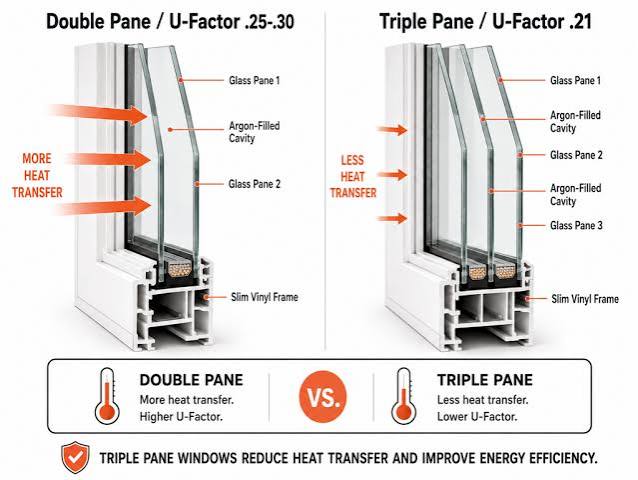
Triple pane can improve thermal performance, depending on the complete system. Choose using the certified ratings and your home’s needs. For sound control, pane count alone is insufficient: thickness, asymmetric glass, lamination, spacing and the complete assembly also matter. Ask for tested acoustic ratings if noise is a priority.
“Is this double or triple pane, and what whole-window performance does this glass package deliver?”
Argon vs. krypton: inside the space
Argon and krypton are insulating gases used between panes. The gas and cavity width work together; evaluate the resulting window ratings rather than the gas name alone. Gas mixtures diffuse and mix.
“What gas fill is specified in this exact insulating glass unit?”
Low-E: a thin coating with a specific job
Low-E coatings are very thin metallic or metal-oxide layers that affect radiant heat transfer. Coating count or “more silver” alone does not establish a better window. Compare the certified performance of the complete system.
“Which Low-E glass package is included in this quote, and what are the resulting NFRC U-Factor and SHGC?”
Warm-edge spacers: the perimeter matters
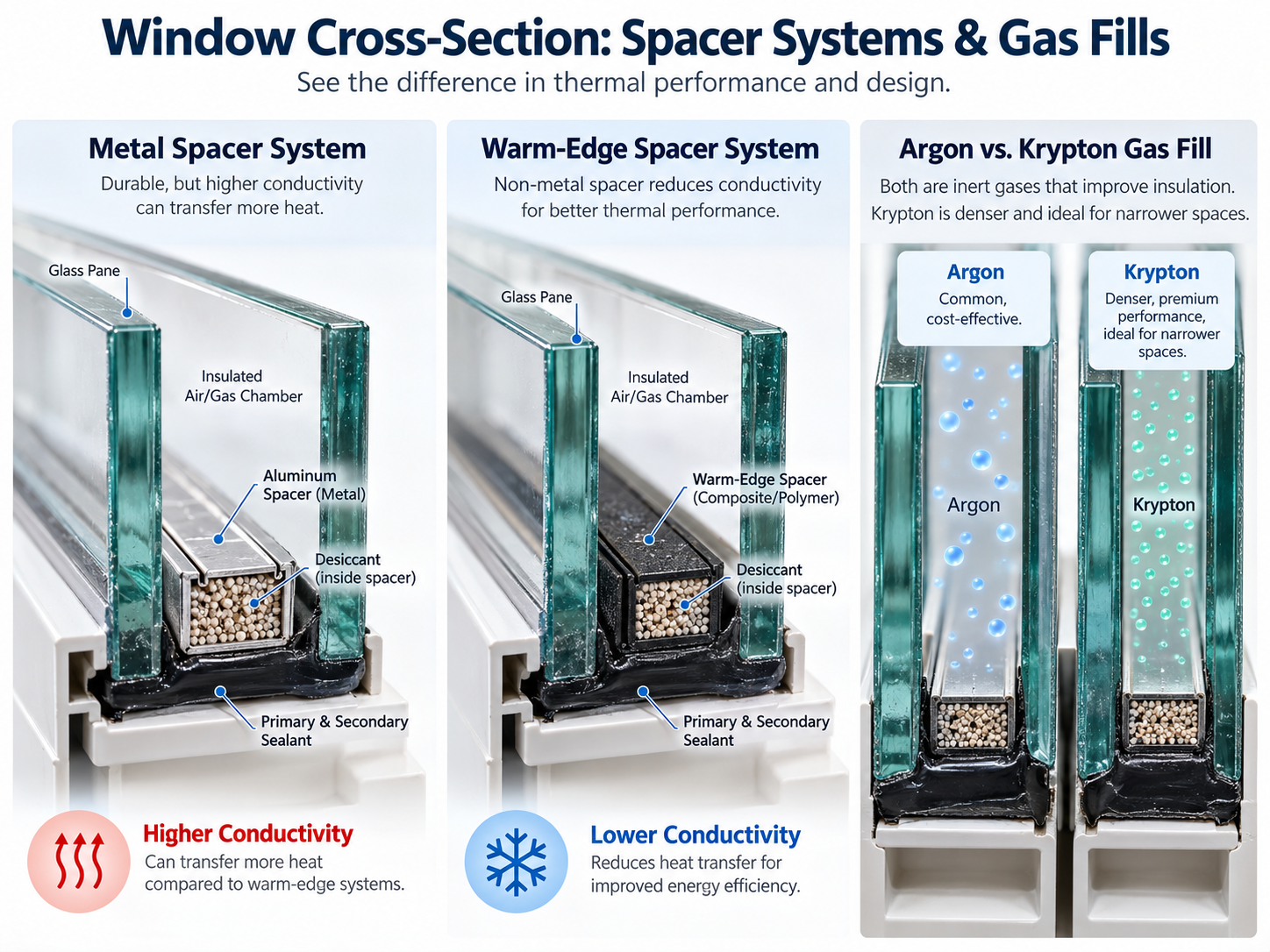
Spacer design affects heat transfer at the glass edge and can influence edge condensation performance. Ask which warm-edge system is included, and compare the complete window’s ratings.
“What spacer system does this window use? Is it a warm-edge system?”
Air leakage: a closed window can still leak
Air leakage is different from DP. It may be reported in cfm/ft² (cubic feet per minute per square foot) at a specified test pressure. Compare rates under equivalent test conditions. PG does not reveal the exact measured rate; obtain the manufacturer’s tested or certified information when available. Installation air sealing matters too.
“What is the tested air-leakage rate for this exact window, in cfm/ft², and at what test pressure?”
Show me the label. Then verify the window.
Example manufacturer
Example window / glass configuration
*May appear where applicable. Ask for tested information if absent. Numbers are examples.
DP / PG is separate structural performance information.
- SHOW ME THE LABEL
- GET THE CPD / PRODUCT IDENTIFICATION
- VERIFY IN THE NFRC CERTIFIED PRODUCTS DIRECTORY
- COMPARE THE ACTUAL WINDOW BEING SOLD
NFRC means National Fenestration Rating Council, an independent nonprofit organization. Its certification and rating system supports standardized energy-performance comparisons. Match the label and directory entry to the product in your quote.
Open the NFRC Certified Products Directory ↗“Please show me the NFRC label for the exact window you’re quoting and give me the CPD/product identification so I can verify it.”
Fogging: where is the moisture?
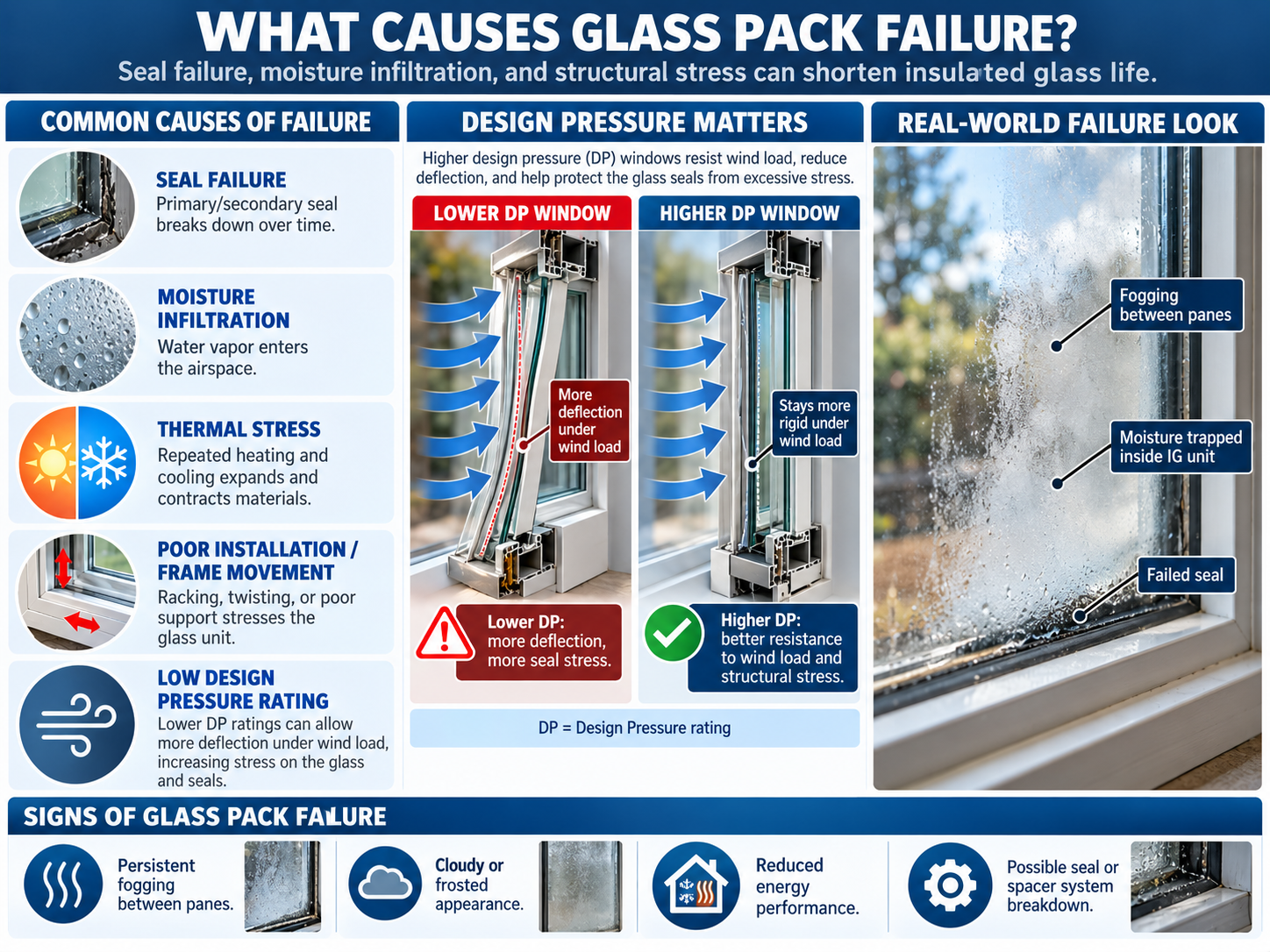
Repeated heating and cooling, moisture exposure, aging seals and installation or frame movement can contribute to insulating-glass seal failure. Persistent moisture trapped between panes differs from condensation on an exposed glass surface. A higher DP alone does not guarantee seal life; compare the certified product and written glass/seal warranty.
“How does the warranty handle moisture between the panes, and who handles the service claim?”
“Lifetime” is a headline. Read the coverage.
Coverage can differ for glass, insulating-glass seals, frame, sash, hardware and labor. Determine how long each is covered, whether it becomes prorated, whether it transfers, and which exclusions or installation requirements apply. A product warranty and a workmanship warranty may come from different parties.
“If the insulated glass fails, exactly what does the warranty pay for, and who pays the labor?”
QuoteGeni 3-Quote Window Comparison Sheet
Ask every contractor the same questions. Write DON’T KNOW when an answer is missing, then request the supporting product information.
Home / project: ____________________ Date: __________
Missing answer? Write DON’T KNOW and request verification.
| QUESTION | QUOTE A | QUOTE B | QUOTE C |
|---|---|---|---|
| Manufacturer | DON’T KNOW ☐ | DON’T KNOW ☐ | DON’T KNOW ☐ |
| Exact series / model | DON’T KNOW ☐ | DON’T KNOW ☐ | DON’T KNOW ☐ |
| Exact window configuration (style / size / options) | DON’T KNOW ☐ | DON’T KNOW ☐ | DON’T KNOW ☐ |
| NFRC label shown? YES / NO | YES / NODON’T KNOW ☐ | YES / NODON’T KNOW ☐ | YES / NODON’T KNOW ☐ |
| CPD / product ID | DON’T KNOW ☐ | DON’T KNOW ☐ | DON’T KNOW ☐ |
| DP (psf) | DON’T KNOW ☐ | DON’T KNOW ☐ | DON’T KNOW ☐ |
| PG | DON’T KNOW ☐ | DON’T KNOW ☐ | DON’T KNOW ☐ |
| NFRC whole-window U-Factor | DON’T KNOW ☐ | DON’T KNOW ☐ | DON’T KNOW ☐ |
| SHGC | DON’T KNOW ☐ | DON’T KNOW ☐ | DON’T KNOW ☐ |
| VT, if relevant | DON’T KNOW ☐ | DON’T KNOW ☐ | DON’T KNOW ☐ |
| Tested air leakage (cfm/ft²) | DON’T KNOW ☐ | DON’T KNOW ☐ | DON’T KNOW ☐ |
| Air-leakage test pressure | DON’T KNOW ☐ | DON’T KNOW ☐ | DON’T KNOW ☐ |
| Double / triple pane | DON’T KNOW ☐ | DON’T KNOW ☐ | DON’T KNOW ☐ |
| Low-E package | DON’T KNOW ☐ | DON’T KNOW ☐ | DON’T KNOW ☐ |
| Gas fill | DON’T KNOW ☐ | DON’T KNOW ☐ | DON’T KNOW ☐ |
| Spacer system | DON’T KNOW ☐ | DON’T KNOW ☐ | DON’T KNOW ☐ |
| Glass / seal warranty | DON’T KNOW ☐ | DON’T KNOW ☐ | DON’T KNOW ☐ |
| Product warranty | DON’T KNOW ☐ | DON’T KNOW ☐ | DON’T KNOW ☐ |
| Installation / labor warranty | DON’T KNOW ☐ | DON’T KNOW ☐ | DON’T KNOW ☐ |
| Transferability | DON’T KNOW ☐ | DON’T KNOW ☐ | DON’T KNOW ☐ |
| Installed price | $DON’T KNOW ☐ | $DON’T KNOW ☐ | $DON’T KNOW ☐ |
Get educated. Get quotes. Make a smarter choice.
Now you know what to ask. Use your sheet to compare the products, installation and warranties behind each price.
Ready to compare local window quotes?Review the guide ↑- NFRC: ratings and label explanations · Certified Products Directory
- FGIA: DP / PG and tested performance
- DOE: window performance, coatings, gas fills and spacers (PDF)
- Cardinal: glass configuration and sound control (PDF)
- Andersen: between-pane condensation and seal failure
Diagrams are educational illustrations, not certifications or promises of specific product performance.